
Château Les Hauts de Caillevel
At the summit of the Pomport Plateau, in the southern Bergerac region, Château Les Hauts de Caillevel spans 23 hectares in a single block in the Dordogne. The estate overlooks the hills of Sigoulès and is set in a particularly unspoiled environment, nestled among the plateau, hillsides, and forest. Below, the Gardonette River brings a refreshing breeze...
1 product

Everything You Need to Know About Château Les Hauts de Caillevel
At the summit of the Pomport plateau, in the southern Bergerac region, Château Les Hauts de Caillevel spans 23 hectares in a single block in the Dordogne. The estate overlooks the hills of Sigoulès and is set in a particularly unspoiled environment, nestled among the plateau, hillsides, and forest. Below, the Gardonette River brings welcome coolness to the vineyard and, thanks to the morning mists, creates conditions ideal for producing Monbazillac wines. The name “Caillevel” comes from the French word “caillou” (pebble), referring to the rock upon which the estate is built.
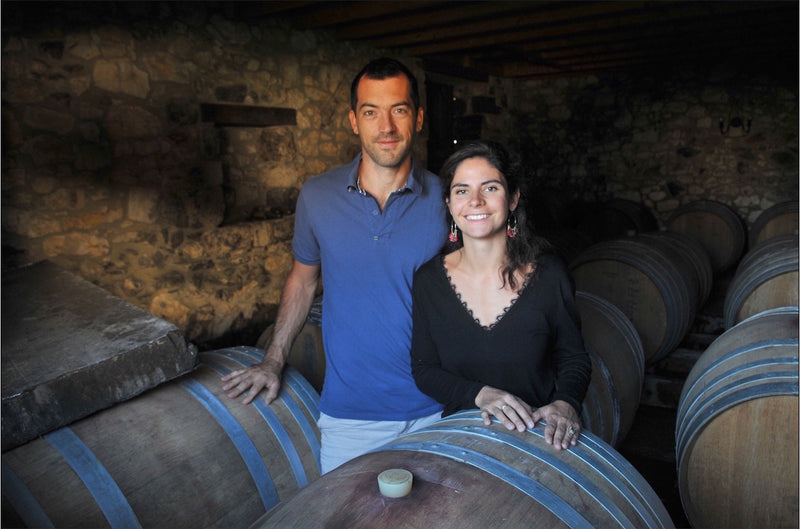
The estate’s recent history is one of a true life-changing journey. After eight years in the aerospace industry, Pierre-Étienne Serey decided to switch careers and pursue winemaking. Together with Charlotte, who previously worked in management and marketing, he took over Les Hauts de Caillevel in 2018 and moved onto the property with their four children. Captivated by the beauty of the place and its potential, they chose to make this estate much more than just a career: a new way of life, in tune with nature and the seasons.
The vineyard has been farmed organically since 2010, with a commitment to going even further in protecting the environment. Charlotte and Pierre-Étienne are developing agroforestry by planting honey-producing hedges, fruit trees, and various shrubs around the plots. Flowering fallow fields are also established on the vineyards during the off-season to promote biodiversity. Treatments rely on mineral and natural preparations—including those made from plants, copper, and sulfur—used in very low doses.
The estate is also known for the diversity of its grape varieties. Sauvignon Blanc, Sauvignon Gris, Chenin, and Ugni Blanc make up the white wines, while Merlot, Cabernet Franc, and Cabernet Sauvignon produce the reds. Malbec is used primarily in the rosé, while Sémillon and Muscadelle are reserved for Monbazillac wines. These ten grape varieties are grown on the karstic rocks of the Monbazillac plateau and on clay-limestone slopes, allowing the estate to offer wines with very different profiles, ranging from fresh and fruity to richer vintages suitable for aging.
In the winery, the approach is a natural extension of the work done in the vineyard. Interventions are kept to a minimum, and the wines are produced with minimal inputs, using primarily sulfur and, when necessary, natural yeasts. Some cuvées are vinified without fining or filtration, such as Les Terres Chaudes, which is made from a selection of the best plots and aged for 15 months in oak barrels.
From Bergerac reds to dry whites, including rosés and Monbazillac, Château Les Hauts de Caillevel showcases the full richness of the Southwest. A family-owned estate driven by a bold shift toward organic farming, where biodiversity and a variety of grape varieties allow Charlotte and Pierre-Étienne Serey to bring a unique terroir to life with wines that are precise, generous, and deeply rooted in their landscape.


