
Marie-Thérèse Chappaz: Winemaker in Switzerland
Could you start by giving us an overview of your vineyard?
My vineyard covers an area of 15 hectares, where cultivation has been guided by our organic and biodynamic certifications for over 20 years.
Our estate offers a diverse range of 24 grape varieties, reflecting the richness and variety of our terroirs: Chasselas, Pinot Noir, Petite Arvine, Marsanne, Gamaret, Galotta, Diolinoir, Païen (Savagnin), Sylvaner, Pinot Blanc, Humagne Rouge, Humagne Blanche, Syrah, Merlot, Cabernet Franc, Cabernet Sauvignon, Completer, Gamay, Cornalin, Durize, Roussane, Rèze, and Diolle.
Spanning altitudes ranging from 450 m to 650 m, the vineyards draw their distinctive character from different terroirs: granitic in Fully, and limestone in Charrat and Chamoson.
In recent years, we have also replanted old indigenous grape varieties.
What is the ratio of white to red wines? Among the whites, which grape variety surprises you the most? And how would you describe the identity of Pinot Noir in Valais?
We produce 8 white wines, 15 red wines, and 1 rosé.
For me, the most surprising grape variety is “Compléter.” It’s an old variety native to the canton of Graubünden, with just 4 hectares planted throughout Switzerland—a little over 3 of which are in Graubünden. This variety thrives in Valais, which is why we’ve replanted it.
Pinot Noir thrives on the left bank of the Rhône, which is the side with the least sun exposure. On these very cool terroirs, it produces some truly lovely wines.
Choosing the right harvest date and vinifying Pinot Noir “just right” is often a challenge. It’s demanding and rewarding at the same time, but when “everything falls into place,” the result is finesse and power. Few grape varieties combine these two characteristics so well.
How did the last harvest go?
After a 2022 vintage that could be described as “easy,” and following the challenges we faced in 2021, we can say that the 2023 harvest went quite well. The harvested grapes were beautifully ripe, and the winemaking process is proceeding as we had hoped. It will be a lovely vintage.
In recent years, there has been a growing awareness of the benefits of biodynamic viticulture, and you were one of the pioneers in this field. Is it a matter of trying to convince reluctant winemakers, or is it more of a personal commitment?
Above all, I believe we must lead by example, and in my view, practicing organic farming is the foundation—the most basic step.
After that, everyone must find their own path. For my part, I strive to make myself available at the estate to anyone who wants to learn more about biodynamics, which is not a science but benefits from the collective experience, shared insights, and successes of everyone involved.
Nature provides the fruit, and you then bring out its best. What is the Chappaz “recipe” in the vineyards and in the cellars? I imagine your approach evolves every year…
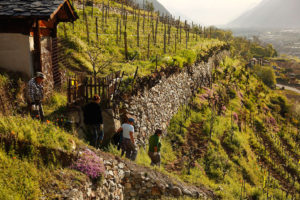
We take the time to observe the vines; we try to understand them as best we can. This is essential for us and is almost a form of preventive care.
When we strive to understand the harmony between vine, terroir, and vintage—all within a setting rich in biodiversity—then we can hope to achieve a fine harvest.
Opting for low yields, allowing native yeasts to flourish, adjusting extraction based on the grape variety and terroir, and avoiding a one-size-fits-all approach are our guiding principles.
What is it about this vineyard—which you know like the back of your hand—that fills you with wonder?
In Valais, the vineyards nestled against or surrounded by the mountains are a constant sight. I feel a sense of fulfillment in the fall when everything settles down. The grapes are safely stored in the cellar, and the vines take on a fiery hue as they replenish their reserves.
Life has brought you to Switzerland, but is there another region in the world where you’d like to make wine?
I think I would have loved to be a winemaker in Provence, specifically around Bandol, where I really enjoy the wines. I’m always in awe of the light that shines so brightly in that region…
Latest Releases
Newly Arrived Vintages in Cellar


